

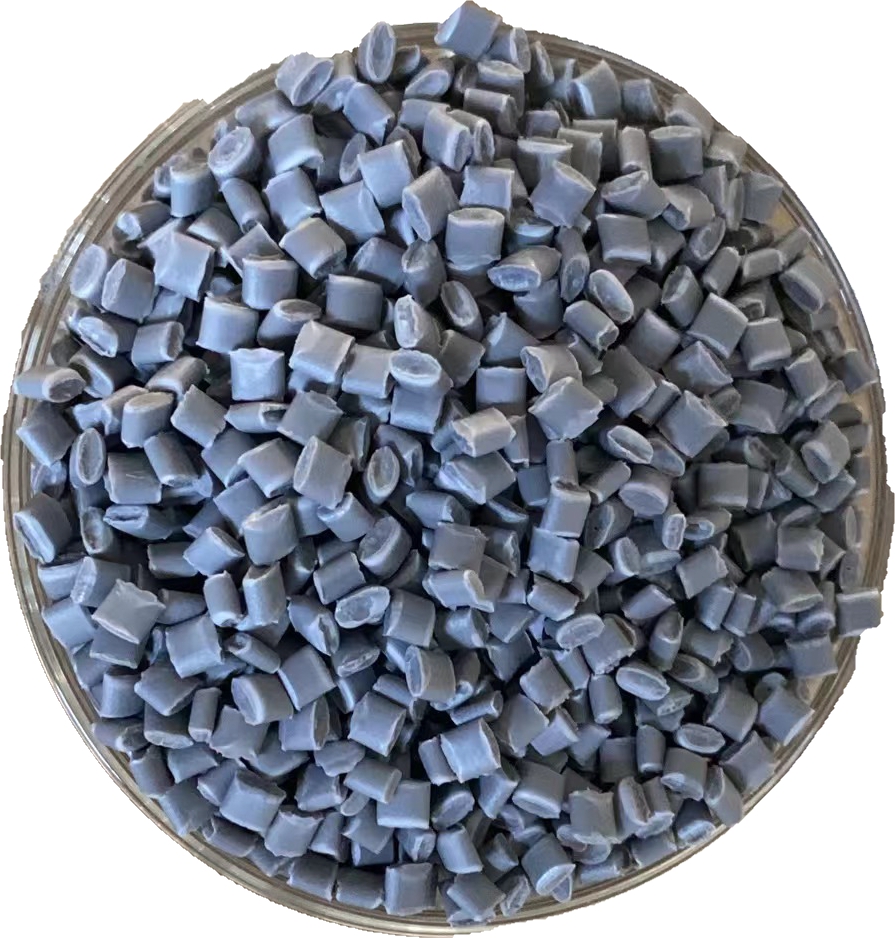
Product Specification: High-Performance Extrusion Grade Modified Polypropylene (PP-LT-1431)
Key Features: Extreme Low-Temperature Resistance, High Rigidity, Dimensional Stability
1. Product Overview
PP-LT-1431 is a specialty modified Polypropylene (PP) grade engineered specifically for the extrusion process. While standard PP often becomes brittle and fails in cold environments, PP-LT-1431 overcomes this limitation through advanced thermoplastic elastomer toughening and high-performance mineral reinforcement.
This material achieves a rare balance between extreme cold-impact strength and superior flexural modulus. Its molecular design ensures high melt strength, making it ideal for the continuous production of large profiles, complex cross-sections, and thin-walled pipes.
2. Core Advantages
Exceptional Low-Temperature Ductility: Maintains high impact resistance at temperatures as low as $-20^\circ\text{C}$ and below, preventing cracking in arctic climates or cold-chain environments.
Superior Rigidity & Creep Resistance: The high-modulus formulation ensures that extruded profiles resist deformation under heavy loads or long-term structural stress.
Excellent Dimensional Stability: Featuring a very low Coefficient of Linear Thermal Expansion (CLTE), this grade minimizes post-extrusion shrinkage and thermal warping, ensuring tight tolerances in precision assemblies.
Optimized Extrusion Processability: Stable Melt Flow Rate (MFR) and high melt strength allow for uniform wall thickness and a smooth surface finish, reducing scrap rates during production.
Chemical & Environmental Resistance: Inherits the excellent acid and alkali resistance of PP while meeting global environmental compliance standards.
3. Technical Data Sheet (Typical Values)
Property | Test Method | Unit | Typical Value |
Density | ISO 1183 | $\text{g/cm}^3$ | 1.05 - 1.15 |
Melt Flow Rate ($230^\circ\text{C}/2.16\text{kg}$) | ISO 1133 | $\text{g/10min}$ | 1.0 - 3.0 |
Flexural Modulus | ISO 178 | $\text{MPa}$ | 2,200 - 2,600 |
Charpy Notched Impact ($-20^\circ\text{C}$) | ISO 179 | $\text{kJ/m}^2$ | ≥ 10 |
Heat Deflection Temp ($0.45\text{MPa}$) | ISO 75 | $^\circ\text{C}$ | 125 - 135 |
CLTE (Coefficient of Thermal Expansion) | ASTM D696 | $10^{-5}/^\circ\text{C}$ | < 6 |
4. Application Fields
Thanks to its dual-strength profile (rigidity + cold resistance), PP-LT-1431 is widely adopted in:
I. Cold Chain & Refrigeration Engineering
Applications: Cold storage shelf profiles, refrigerated truck interior trims, industrial freezer structural components.
Benefit: It does not embrittle at $-30^\circ\text{C}$ and can withstand the pressure of stacked heavy goods.
II. Automotive Industry (Extruded Profiles)
Applications: Internal supports for weatherstrips, mudguard reinforcements, underbody aero-shields, and anti-rub decorative strips.
Benefit: Ensures structural integrity in sub-zero regions and maintains precise fitting at high speeds.
III. Construction & Infrastructure
Applications: Outdoor formwork support strips, highway anti-glare boards, cable protection conduits, and outdoor fencing profiles.
Benefit: A rust-proof, aging-resistant alternative to metal or wood with high structural stiffness.
IV. Logistics & Heavy-Duty Packaging
Applications: Reinforced frames for hollow-sheet containers, heavy-duty pallet ribs, and edge protection strips for transit cases.
Benefit: Resists damage from repeated drops and impacts, significantly extending the service life of logistics equipment.
5. Processing Guidelines
Drying: Although PP absorption is minimal, drying at $80^\circ\text{C}$ for 1.5–2 hours is recommended to ensure a defect-free surface finish.
Extrusion Temperature Settings:
Feed Zone: $180^\circ\text{C} - 200^\circ\text{C}$
Compression Zone: $200^\circ\text{C} - 220^\circ\text{C}$
Die Head: $210^\circ\text{C} - 230^\circ\text{C}$
Cooling Control: To achieve optimal dimensional stability, use a constant-temperature water bath to prevent warping caused by sudden cooling.