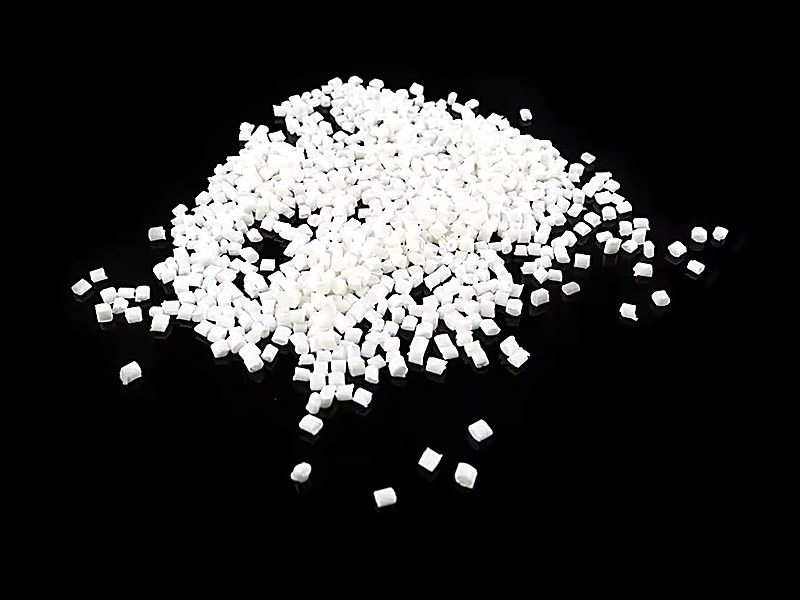
Product Introduction and Application Fields of PC/ABS Alloy (PC 70% + ABS 30%) - Natural Color
1. Product Introduction
PC/ABS Alloy (PC 70% + ABS 30%) - Natural Color is a high-performance engineering plastic prepared by twin-screw blending modification, based on 70% polycarbonate (PC) and 30% acrylonitrile-butadiene-styrene copolymer (ABS), with the addition of high-efficiency compatibilizer (ABS-g-MAH) and elastomer impact modifier. It presents a uniform off-white natural color. The high proportion of PC forms a continuous phase, dominating the material's heat resistance, rigidity and impact resistance, while ABS optimizes molding processability and surface compatibility. It achieves the triple advantages of "ultra-high impact toughness + high heat resistance and rigidity + easy processing", and is especially suitable for scenarios with stringent requirements for shatter resistance, deformation resistance and high temperature resistance.
Its core advantages are concentrated in four dimensions:
Outstanding ultra-high impact toughness: Through precise regulation of the toughening system, the notched impact strength (23℃) can reach more than 50 kJ/m², and the low-temperature notched impact strength (-30℃) still remains above 25 kJ/m², far exceeding that of general-purpose PC/ABS alloys. It effectively improves the notch sensitivity of pure PC and greatly reduces the risk of product embrittlement and cracking.
Excellent heat resistance and rigidity performance: The PC continuous phase endows the material with excellent heat resistance and structural stability. The heat distortion temperature (1.8MPa) reaches 110-125℃, the long-term service temperature range is -30℃~120℃, the tensile strength is 63-68MPa, and the flexural modulus is 2.6-3.2GPa, with significantly improved creep resistance and deformation resistance.
Controllable processing adaptability: It retains the excellent injection molding fluidity of ABS, with a melt mass flow rate (260℃/5kg) of 20-28g/10min, which can be adapted to the molding of complex structures and medium-thick wall products. The natural color base material contains no additional colorants, and is easy to be colored, electroplated and sprayed, with strong compatibility for subsequent surface treatment.
Compliance with safety and environmental protection standards: The natural color product complies with RoHS 2.0 and REACH standards in terms of heavy metal content, with low odor and no risk of colorant migration. The PC component has better biocompatibility, making it suitable for high-end consumer goods, automobiles and other fields with high requirements for environmental protection and safety.
2. Core Performance Parameter Table
Performance Item | Test Standard | Unit | Typical Value (PC 70% + ABS 30% Natural Color · Toughened Modification) |
|---|---|---|---|
Tensile Strength | ISO 527-1/-2 | MPa | Approximately 63-68 |
Flexural Strength | ISO 178 | MPa | Approximately 75-82 |
Flexural Modulus | ISO 178 | GPa | Approximately 2.6-3.2 |
Notched Impact Strength (23℃) | ISO 180 | kJ/m² | ≥50 |
Notched Impact Strength (-30℃) | ISO 180 | kJ/m² | ≥25 |
Heat Distortion Temperature (1.8MPa) | ISO 75-1/-2 | ℃ | Approximately 110-125 |
Long-term Service Temperature | Enterprise Standard | ℃ | -30~120 |
Surface Glossiness (60°) | ISO 2813 | GU | Approximately 78-88 (Natural Color Polished) |
Melt Flow Index (260℃/5kg) | ISO 1133 | g/10min | Approximately 20-28 |
Flame Retardant Rating | UL 94 | - | V-0 (Flame-retardant natural color option available with dedicated formula) |
3. Application Fields
Relying on the core advantages of "ultra-high impact resistance, high heat resistance, high rigidity and environmental-friendly natural color", this material is mainly suitable for high-end manufacturing scenarios with high requirements for shatter resistance, deformation resistance and high temperature resistance, and is widely used in various industries:
Automotive Industry: New energy vehicle charging pile housings, structural components in high-temperature areas around engines, instrument panel frames, door anti-collision beam liners, rearview mirror housings. It is suitable for high-temperature and vibration environments within 120℃ in vehicles. The ultra-high impact performance can resist collision damage during driving. Meanwhile, the natural color is environmentally friendly with low odor, meeting the in-vehicle VOC requirements.
Consumer Electronics: Laptop housings and heat dissipation module brackets, smartphone middle frames (natural color can be directly used for base coloring or anodizing), drone fuselage frames, structural components in high-temperature areas of portable printers. It meets the requirements of lightweight design, shatter resistance and heat dissipation. The impact strength of more than 50 kJ/m² can pass the 1.5-meter drop test.
Medical and Health Care: Portable medical device housings (monitors, ultrasonic diagnostic instruments), medical transfer boxes, surgical instrument trays. The ultra-high impact performance ensures the structural integrity of equipment during transportation. The natural color has no risk of colorant migration, complying with medical-grade biocompatibility requirements.
Industrial Protection: Industrial instrument housings, explosion-proof toolboxes, protective covers for outdoor monitoring equipment. It can resist collision and temperature difference changes in complex outdoor environments. Its high heat resistance is suitable for long-term use in outdoor exposure scenarios.
High-end Home Appliances: Microwave oven inner tank brackets, air fryer housings, washing machine drum connectors. It has both ultra-high impact toughness and high temperature resistance, meeting the structural stability requirements for high-frequency use of home appliances.
4. Injection Molding Processing Suggestion Table
Processing Link | Specific Parameter Requirements | Core Function |
|---|---|---|
Raw Material Drying | Drying temperature 100-110℃, drying time 3-4 hours, residual moisture content ≤ 0.02% | Avoid silver streaks and bubbles in products, ensure smooth natural color appearance and stable performance of the toughening system |
Processing Temperature | Barrel temperature: front section 240-250℃, middle section 260-270℃, rear section 230-240℃; nozzle temperature 250-260℃ | Ensure good melt fluidity, avoid toughener decomposition due to excessive temperature (affecting impact performance) or weld lines caused by insufficient temperature |
Mold Temperature | Conventional 60-80℃; 80-90℃ for complex structure/thick wall products | Improve melt filling smoothness, reduce internal stress, prevent product warpage and deformation after cooling, ensure uniform natural color appearance |
Injection Parameters | Injection pressure 90-140MPa (adjust as needed); injection speed: "slow at front section - uniform at middle section - slow at rear section"; holding pressure 50%-70% of injection pressure, holding time 3-6 seconds | Avoid flash and internal stress concentration, ensure dense products without shrinkage cavities, guarantee the full play of ultra-high impact performance |
Screw Speed and Back Pressure | Screw speed 30-50r/min, back pressure 8-12MPa | Improve melt plasticization uniformity, ensure uniform dispersion of PC, ABS and toughener, avoid toughener degradation due to excessive screw speed |
Post-processing | Annealing treatment at 70-90℃ for 1.5-2.5 hours | Eliminate internal stress, further improve product dimensional stability, reduce deformation during use |
Other Precautions | Ensure sufficient mold ventilation; clean the barrel in time after processing (avoid material residue degradation affecting the appearance of subsequent natural color products); avoid using oil-contaminated raw materials and equipment | Prevent gas trapping and material shortage, ensure product quality consistency, avoid oil pollution affecting the cleanliness of natural color appearance |